Concerto for Marimba
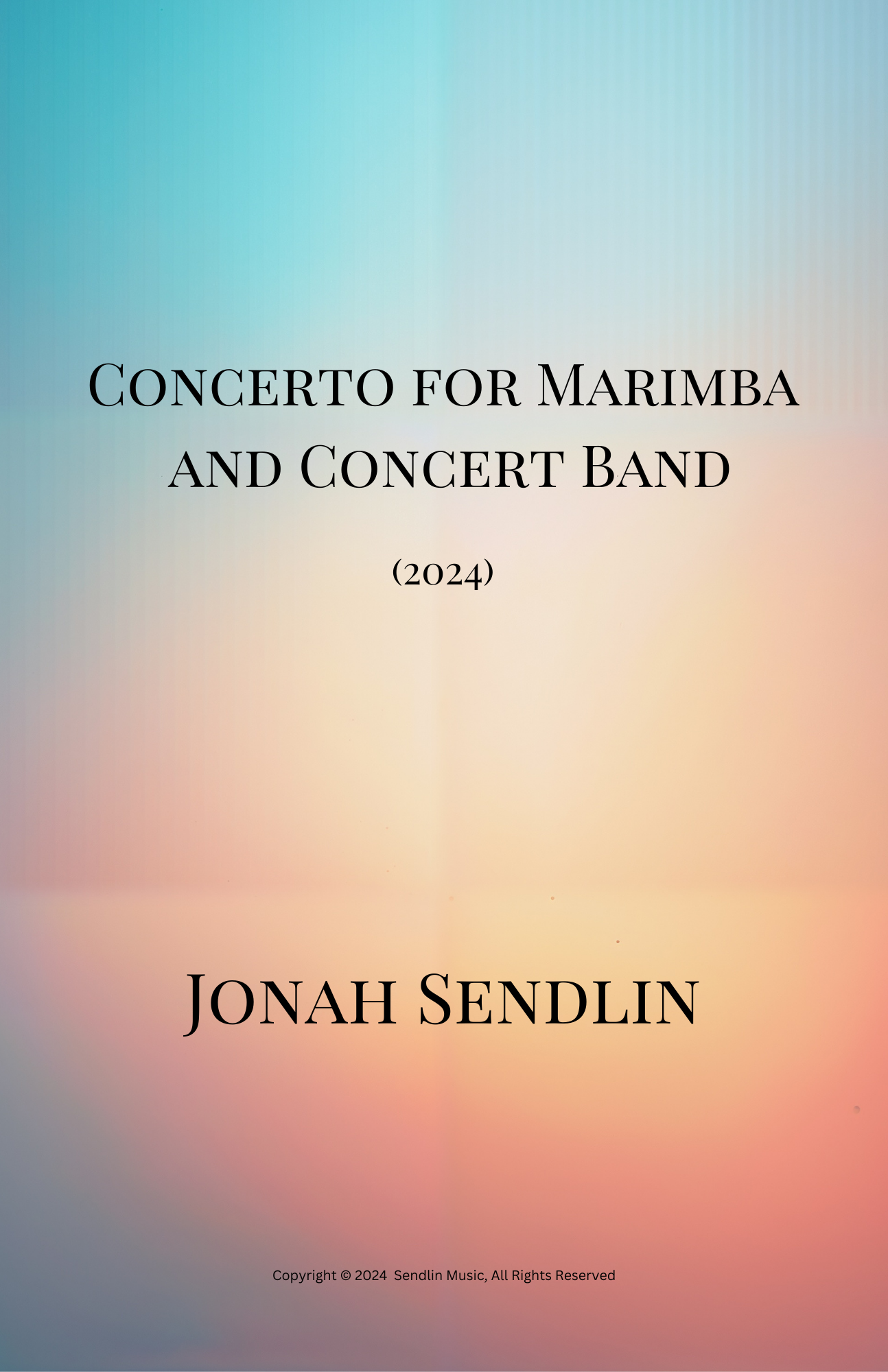
Concert Band + Solo Marimba (grade 5)
Duration: ~20:00
$200
Movements I and III Performed by Bradley University Symphonic Winds Stephen Busath - Marimba, Darrel Brown - Conductor
Program Note
Movement one of Concerto for Marimba establishes the character of the complete work. The off-kilter intro, represented by complex meters, launches into the whimsical main theme. The movement emphasizes the two-mallet technique with quick runs and repeating rhythmic motives. The movement loosely follows a Sonata form, the typical form for most concerti, however, in this movement, it is the soloist that plays the first exposition while the orchestra picks up the melody in the second exposition.
Movement two experiences a brief shift of period from Contemporary to Impressionism. Inspired by Debussy’s Clair De Lune, this movement emphasizes the four-mallet technique with chordal planing, arpeggiations, and rolling. The movement follows an arch form, with each section containing a different key signature. The soloist takes turns passing the melody to different members of the ensemble, and shares moments of call and response.
Movement three of this concerto is a fast-paced, mixed-metered work that emphasizes the four-mallet technique with compound melody. Like the first movement, the third movement follows a loose Sonata form, and like the first movement, the soloist plays the first exposition. This catapults the piece more effectively into the development where a brief moment of silence is interrupted by a grand fanfare-like response. Following the development is a cadenza with fast runs both down and up the marimba, and a groovy polyrhythmic pattern. This concerto has much to be appreciated by performers and audiences alike.
Instrumentation
Solo Marimba
Winds: Piccolo, Flute, Oboe, English Horn, Bassoon, Bb Clarinet 1-3, Bass Clarinet, Contrabass Clarinet, Alto Saxophone 1-2, Tenor Saxophone, Baritone Saxophone
Brass: Bb Trumpet 1-3, Horn 1-4, Trombone 1-2, Bass Trombone, Euphonium, Tuba
Strings: Cello (ad lib. ), Double Bass
Percussion: Timpani, Perc 1. (Glockenspiel), Perc. 2 (Chimes, Conga), Perc. 3 (Triangle, Flexatone, Snare Drum, Conga), Perc. 4 (Castanets, Tam-tam, Bass Drum, Triangle)